Called by all those who know the area as Plateau, The Beautiful, Plateau State is named after the picturesque Jos Plateau. The twelfth largest among Nigeria’s 36 states, Plateau has the unique combination of a mountainous area with captivating rock formations, punctuated by deep gorges, lakes, bare rocks, rivers, and waterfalls that define its grass lands.
Blessed with a clement weather, rich resource base, and a hospitable and industrious people, Plateau State has, for over a century, been a major attraction for people from other parts of Nigeria, and indeed all continents of the world. No wonder the state is acknowledged and celebrated as The Home of Peace and Tourism.
PEOPLE AND CULTURE
Plateau State has been rightly described as a miniature Nigeria because there is hardly any of Nigeria’s ethnic groups that is not found in the State. However, there are over 53 known indigenous ethnic groups. The people are accommodating; have similarities in culture and tradition, and shared hopes and aspirations.
Some of the indigenous ethnic groups in the State are the Berom, Ngas, Taroh, Goemai, Mwaghavul, Youm, Montol, Rukuba, Kwagalak, Piapung, Buji, lrigwe, Mushere, Afizere, Anaguta, Gashish, Pyem, Amo, Mship, Mernyang, Fier, Bogghom, Ron-Kulere, Chawai, Aten etc.
There are other ethnic groups that migrated to the State as a result of mining and trading; and administrative changes. These include the Hausa, Fulani, lgbo, Yoruba, ljaw, Bini, etc. These groups co-exist peacefully with the indigenous people. Generally, this is a State where unity is seen as being compatible with diversity.
The people are predominantly farmers, blessed with a rich cultural heritage which they uphold jealously. This can be seen in the numerous cultural festivals which serve religious purposes, have high entertainment value, and are veritable tools of unity and development.
The cultural traits of the ethnic groups indigenous to the State are interrelated and tend to interface, depending largely on the proximity of one to the other.
Because of her numerous ethnic groups, Plateau State provides some of the dominant traits of Nigeria’s rich cultural heritage. The art, treasures and artifacts of the State occupy significant places of honour in national and international galleries. Dances and songs of Plateau have won distinction and laurels at international and national festivals.
POPULATION
The 2006 census figures show that 3,178,712 million people live in Plateau State. This population is made up of 1,593,033 males and 1,585,679 females. Based on the generally accepted annual of growth of 2%, the state’s population is projected at 3.5million.
OCCUPATION
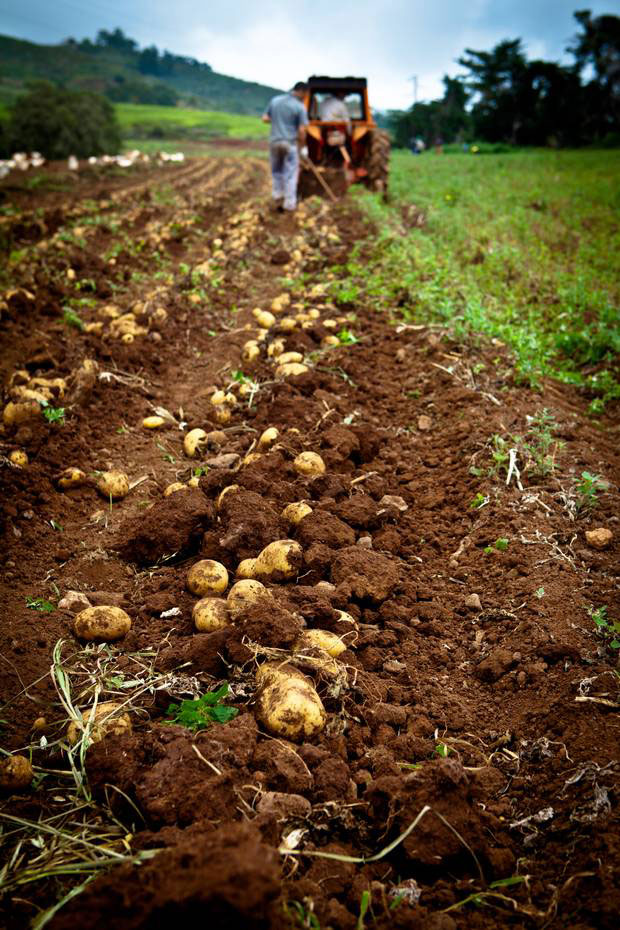
A large percentage of the population of Plateau State is engaged in agriculture which contributes greatly to the nation's food basket and employment generation. Mining is an old industry, small and medium scale businesses thrive, while the local, state and federal public services engage thousands of people.
|
- Location
Plateau State is located in Nigeria’s middle belt. With an area of 26,899 square kilometres, the State has an estimated population of about three million people.
- Climate
Although Plateau State is in the tropics, it has a near temperate climate with an average temperature of between 18.r and 51.70 Fahrenheit while the annual rainfall varies from 131.75cm in the southern part to 146cm on the Plateau. Highest rainfall is usually recorded in July. The weather is always cold between the months of December and February as a result of the harmanttan winds. Even though the temperatures appear highest between March and April, Plateau weather remains the coolest in Nigeria, a weather condition that contributes significantly to the high concentration of expatriates in the state. Further, the State's topography is not just characterized by picturesque landscape with undulating highlands, it is the hydrographical head of many rivers, some of which are fast flowing and have formed waterfalls such as Assop and Kura Falls. Kura Falls in particular is being used in generating electricity by NESCO, a private firm.
- Geology
The Jos Plateau is thought to be an area of younger granite which was intruded through an area of older granite rock, making up the surrounding states.
- History
For many centuries, most of the communities in what today constitutes Plateau State were largely autonomous polities. This was, however, to change with the conquest and imposition of colonial rule at the beginning of the twentieth century, as the communities were lumped into, and administered as part of Bauchi Province. In a reorganization exercise that was necessitated by the socio political realities that had unfolded, and to re-align the colonial objective to the times, Plateau Province was one of the Provinces created in the Northern Region in 1926. This administrative structure remained throughout the colonial era, and during the first six years of independent rule.
In 1967, the Federal Military Government, under the leadership of General Yakubu Gowon restructured the four regions and their provinces into 12 states. One of the entities given birth to in that exercise was Benue-Plateau State, made up of the Provinces of Benue and Plateau, and part of Muri Province.
The first person to preside over the affairs of this territory as Governor is the late Commissioner of Police Joseph Dechi Gomwalk, acclaimed and celebrated for his vision, outstanding works and heroic deeds. He was Governor of Benue Plateau State between 1967-1975. He was succeeded by Col. Abdullahi Mohammed, who was military governor between 1975-1976.
Another state creation exercise was carried out by the General Murtala Ramat Mohammed regime on February 3, 1976 which saw to the emergence of Benue and Plateau as distinct and separate states. Twenty years later, precisely on October 1, 1996, Plateau State was affected by yet another state creation exercise when Nasarawa State was carved out of it by the General Sani Abacha regime.
|
|
|